How to Write a Winning Personal Statement for Scholarships and University Applications
How to Write a Personal Statement | Complete Guide for Scholarships
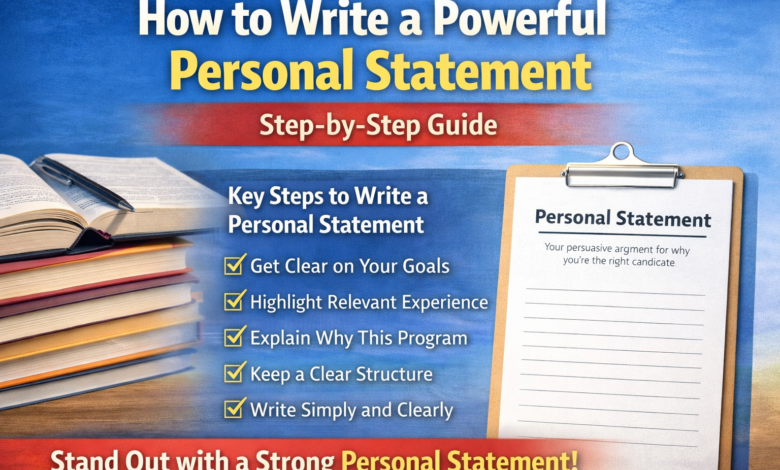
If you’re applying for scholarships, university programs, or job opportunities, understanding how to write a personal statement can make or break your application. Moreover, your personal statement serves as your voice in a sea of applications, giving reviewers insight into who you are beyond grades and test scores.
Let’s be honest. Most personal statements sound identical. They’re filled with big words, vague ambitions, and recycled phrases like “I have always been passionate…” Furthermore, admissions officers read hundreds, sometimes thousands, of them. If yours feels generic, it simply disappears into the pile.
However, the good news? Learning how to write a personal statement isn’t about being dramatic or poetic. Instead, it’s about being clear, focused, and intentional. This comprehensive guide shows you exactly how to write a personal statement that captures attention and increases your chances of acceptance.
For more application tips, check our guide on Writing Winning Scholarship Applications.
What Is a Personal Statement Really?
Before diving into how to write a personal statement, you must understand what it actually is.
A personal statement is NOT:
- Your CV rewritten in paragraph form
- Your complete life story
- A motivational speech
Instead, it’s a structured explanation of:
- Who you are academically or professionally
- What you want to study (or pursue)
- Why you’re choosing this specific path
- Why this particular program fits your goals
- What unique qualities make you a strong candidate
Think of it as your strategic argument. Essentially, you’re demonstrating why selecting you makes logical sense for the program.
Step 1: Get Clear Before You Start Writing
Before learning how to write a personal statement effectively, pause and answer these critical questions:
Essential Questions:
- Why am I applying for this specific program?
- What exactly do I want to specialize in?
- What experiences prepared me for this field?
- What are my realistic long-term goals?
If you can’t answer these clearly, your statement will feel scattered. Therefore, achieve clarity first, then begin writing second.
Remember, strong personal statements are built on clear direction.
Step 2: Write a Focused Introduction
When learning how to write a personal statement, many applicants struggle with the opening. However, you don’t need drama—you need direction.
Avoid These Common Mistakes:
❌ Don’t Use:
- Overused quotes from famous people
- Emotional childhood stories that don’t connect to your field
- Big, vague statements about “changing the world”
Instead, Do This:
✅ Start With:
- A defining research project you completed
- A key academic experience that shaped your interests
- A professional challenge that clarified your goals
Moreover, keep it concise. The introduction should immediately show what your focus is and where you’re headed.
Example Opening: “During my undergraduate research on renewable energy storage, I discovered a critical gap in current battery technology. This finding solidified my commitment to pursuing advanced materials engineering.”
Learn more in our Personal Statement Examples That Worked article.
Step 3: Highlight Your Academic Background with Purpose
This section of how to write a personal statement answers one key question: Why are you prepared for this program?
Important: Don’t list everything you’ve studied. Instead, focus only on what is directly relevant to your application.
What to Include:
Talk About:
- Important courses that shaped your understanding
- Significant research projects
- Academic achievements with measurable impact
- Specific skills you developed
Show, Don’t Just Tell:
Weak Example: “I studied economics and did well.”
Strong Example: “During my undergraduate studies in economics, I developed a strong interest in development policy after completing a research project on rural entrepreneurship that surveyed 200 small business owners.”
Notice how specific details build credibility? That’s essential when learning how to write a personal statement.
Additionally, explore How to Showcase Your Academic Achievements for more tips.
Step 4: Connect Your Experience to Your Future Goals
This is where many applicants fall short when learning how to write a personal statement.
They talk about the past, but they don’t connect it to the future clearly.
The Winning Formula:
Your statement should flow like this: Past → Present → Future
Specifically:
- What you studied or worked on (Past)
- What you learned from those experiences (Present)
- Why that led you to apply (Present)
- What you plan to accomplish after completing the program (Future)
Admissions committees want to see clear direction. Indeed, if your goals are unclear, they may question your commitment to the program.
Example Connection: “My research on healthcare disparities in rural communities (Past) revealed systemic barriers in medical supply chains (Present). Therefore, I’m applying to this public health program to develop sustainable distribution models (Future), ultimately working with international health organizations to implement these solutions in underserved regions (Long-term goal).”
Step 5: Explain Why This Specific Program
This is one of the most crucial parts of how to write a personal statement that many applicants ignore.
Show That You’ve Done Your Research:
Mention Specifically:
- Particular courses or modules that align with your interests
- Research centers or faculty whose work excites you
- Unique strengths of the institution
- How the program specifically aligns with your goals
Avoid Empty Praise: Don’t write: “This university is prestigious and highly ranked.”
That doesn’t add value or show you understand how to write a personal statement effectively.
Instead, Write: “Professor Smith’s research on artificial neural networks aligns perfectly with my interest in machine learning applications. Moreover, your AI Ethics Lab offers the collaborative environment I need to explore responsible AI development—a focus rarely found in other programs.”
Step 6: Keep a Clear Structure
When mastering how to write a personal statement, structure matters tremendously.
Recommended Structure:
A strong personal statement usually follows this logical flow:
- Introduction (clear focus and hook)
- Academic background (relevant preparation)
- Relevant experience (what you’ve accomplished)
- Career goals (where you’re headed)
- Why this program (specific fit)
- Conclusion (confident and forward-looking)
Furthermore, avoid jumping between ideas randomly. Instead, keep your argument logical and clean throughout.
Step 7: Write Clearly, Not Impressively
Here’s something important about how to write a personal statement: Complicated vocabulary does not impress. Clear thinking does.
Avoid These Writing Pitfalls:
❌ Don’t:
- Use long, confusing sentences
- Include unnecessary jargon
- Employ overly emotional language
- Try to sound like someone you’re not
✅ Instead: Write in a professional but natural tone. Specifically, imagine explaining your academic goals to a respected mentor. Be clear, direct, and honest.
Weak Example: “I have endeavored to cultivate an unparalleled proficiency in the multifaceted domain of computational linguistics.”
Strong Example: “I’ve spent three years developing my skills in computational linguistics through coursework and two research projects analyzing language patterns in social media.”
Additionally, read our Academic Writing Tips for International Students.
Step 8: Show Evidence, Don’t Just Make Claims
This is critical when learning how to write a personal statement that stands out.
Replace Claims with Evidence:
Weak (Just Claims): “I am a natural leader with excellent communication skills.”
Strong (Evidence-Based): “As president of the student association, I coordinated a team of 15 members to organize academic workshops attended by over 300 students, securing $5,000 in sponsorships through targeted outreach.”
See the difference? Evidence always beats empty adjectives when you’re learning how to write a personal statement.
Common Mistakes That Hurt Your Application
Let’s be direct. When learning how to write a personal statement, these mistakes hurt even strong applications:
Critical Errors to Avoid:
❌ Submitting Generic Statements: Using the same statement for multiple programs without customization
❌ Being Vague: Writing unclear career goals like “I want to help people”
❌ Exaggerating Achievements: Making false claims that can be easily verified
❌ Ignoring Word Limits: Submitting 1,500 words when 750 was requested
❌ Skipping Proofreading: Submitting with spelling and grammar errors
Remember, a personal statement should feel tailored and intentional. Moreover, following instructions demonstrates your attention to detail.
How Long Should a Personal Statement Be?
When learning how to write a personal statement, length matters.
General Guidelines:
Typical Length:
- 500–1,000 words for most programs
- Always follow the exact word limit provided
Important Rule: If they request 750 words, don’t submit 1,200. Similarly, don’t submit 400 words thinking brevity impresses. Following instructions matters greatly to reviewers.
Pro Tip: Stay within 10% of the suggested word count. If they want 800 words, aim for 720-880 words.
Personal Statement Checklist: Essential Elements
Use this checklist when learning how to write a personal statement:
Before Submitting, Verify:
✅ Content Check:
- Clear introduction stating your focus
- Specific academic background relevant to program
- Concrete examples supporting your claims
- Clear connection between past and future
- Specific reasons for choosing this program
- Logical flow throughout
- Strong, confident conclusion
✅ Technical Check:
- Within required word limit
- No spelling or grammar errors
- Proper formatting
- Correct program/university name (no copy-paste errors!)
- Professional tone throughout
✅ Strategy Check:
- Tailored specifically to this program
- Shows genuine interest and research
- Demonstrates clear goals
- Highlights unique strengths
- Answers “Why you?” and “Why here?”
Personal Statement Examples by Field
When learning how to write a personal statement, seeing field-specific examples helps.
Engineering Personal Statement Focus:
Emphasize:
- Technical projects and skills
- Problem-solving abilities
- Research experience
- Specific engineering interests
Medical/Healthcare Personal Statement Focus:
Highlight:
- Patient care experiences
- Medical research involvement
- Commitment to healthcare
- Understanding of medical challenges
Business Personal Statement Focus:
Showcase:
- Leadership experiences
- Analytical skills
- Career progression logic
- Specific business interests
For detailed examples, read our Personal Statement Examples by Major guide.
Tips for International Students
If you’re an international student learning how to write a personal statement, consider these additional tips:
Language Considerations:
- Have a native speaker review for clarity
- Avoid idioms that don’t translate well
- Keep sentences straightforward
- Use active voice predominantly
Cultural Differences:
- Western applications value directness
- Don’t be overly modest about achievements
- Balance humility with confidence
- Show initiative and independence
How to Edit Your Personal Statement
Knowing how to write a personal statement includes mastering the editing process.
Editing Strategy:
Round 1 – Content:
- Does each paragraph have clear purpose?
- Are examples specific and relevant?
- Is the logic flow clear?
Round 2 – Clarity:
- Can sentences be shorter?
- Are there unnecessary words?
- Is the tone professional?
Round 3 – Technical:
- Grammar and spelling correct?
- Formatting consistent?
- Word count within limits?
Round 4 – Fresh Eyes:
- Ask someone to read it
- Get honest feedback
- Make final adjustments
Furthermore, take breaks between editing rounds. Fresh eyes catch more mistakes.
Final Thoughts on How to Write a Personal Statement
In conclusion, understanding how to write a personal statement that stands out is not about sounding impressive. Instead, it’s about clearly showing:
- Clear academic and career direction
- Strong preparation through experiences
- Logical, achievable goals
- Genuine fit with the specific program
Moreover, if you take time to reflect honestly, structure your ideas properly, and write with clarity, your personal statement will stand out for the right reasons.
Remember, learning how to write a personal statement isn’t just about getting accepted. Indeed, this process forces you to think seriously about your future academic and career goals. That clarity alone is tremendously valuable.
Ready to start? Use this guide on how to write a personal statement to craft an application that showcases your unique strengths and genuine passion. Your dream program awaits!
Related Articles on WorldScholarship.net:
- Personal Statement Examples That Worked
- Scholarships That Don’t Require IELTS or TOEFL (And How to Apply)
- MIT Free Online Courses 2026


One Comment